Special techniques for creating unique, artistic, close-up images
Macro, or close-up, photography is gaining popularity, and this book covers all of the challenges associated with taking great close-ups: depth of field, focus, and exposure. Copublished with Photoworkshop.com, a leading online educational resource for both beginning and professional photographers, this task-oriented reference allows readers to learn by doing and offers outstanding examples and instructions.
- English
- ePUB (mobile friendly)
- Available on iOS & Android
eBook - ePub
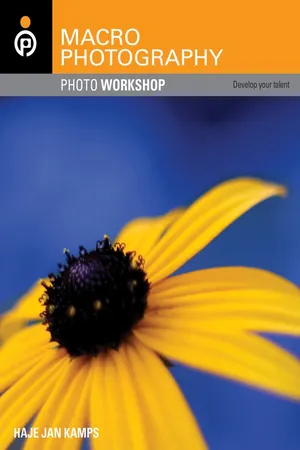
Macro Photography Photo Workshop
About this book
Trusted by 375,005 students
Access to over 1.5 million titles for a fair monthly price.
Study more efficiently using our study tools.
Information
Chapter 1: First Steps Into a Macro World

What is Macro Photography?
The Challenge of Macro Photography
Can I Afford to be a Macro Photographer?
Why Anyone Can Take Great Macro Photographs
Try It Now
You have purchased a camera, and you are ready to explore the world of tiny subjects, details, and small things. There is a whole new world out there to be explored, with a vast number of exciting opportunities. Everywhere around you there are fascinating patterns, shapes, and items that look amazing if you get close enough.
By the end of this chapter, you will have your first tastes of macro photography, you will understand some of the theory behind it, and you will see some astounding photos that give you something to aim for as you start honing your macro photography skills.
What is Macro Photography?
Macro photography is the art of taking pictures of subjects up close. Some photos might be of relatively large things — such as a hummingbird or a large flower — and others might be of minuscule objects, such as the compound eye of a fly. However, macro photography isn’t just about taking pictures of small things; it can also be detail shots of bigger subjects. In fact, some of the photos in this book are detail photos of skyscrapers!
To many macro photographers, taking pictures is about capturing phenomena, items, and events that cannot easily be seen with the naked eye. A droplet falling onto a plate (see 1-1), a hummingbird in flight (see 1-2), or bubbles rising up in a glass of champagne can be seen every day; but, unless you freeze their motion, it is impossible to fully appreciate their beauty or study them in detail. The delicate structure of a bubble or the intricate detail of an orchid might remain forever mysterious to us.

If you are curious about the technical definition of a macro photograph, that is a grayer area. Historically, the definition was that the image had to be on the scale of 1:1 on the negative. This means that if you took a picture of a coin, you could put the coin on the developed negative, and the picture of the coin was exactly the same size as the coin.
Some sources claim that to be considered a macro photograph, the subject has to be the same size as — or larger than — its reproduction in print, as illustrated in 1-3. In other words, when you have your images printed, the prints you receive have to be a 1:1 reproduction of the coin. To me, this seems a bit impractical, because almost any photo you take can be a macro photo: You just need to enlarge the negative.
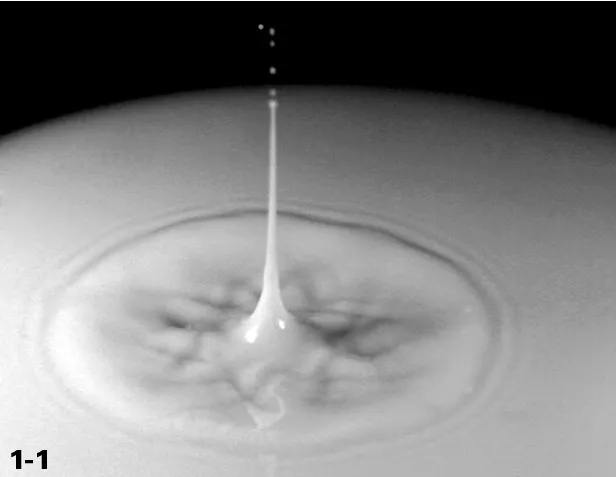
1-1: This photo of milk falling into a saucer was lit with 2x500W floodlights. Taken with a Canon 135mm f/2.8 Soft Focus prime lens. 1/4000 sec., f/3.5 at ISO 100.
Ultimately, the definition of macro photography has changed over time — and digital technology has changed it even more. Macro photography has morphed into the act of taking pictures of small areas of a larger subject or of small subjects. That is as good a definition as any. I’m not here to split hairs; I’m in the business of taking pictures of them.
It is important to remember that anything can become a macro subject. Although two of the most eye-catching areas of macro photography are insects and flowers, you can explore many other subject options up close. The textures and shapes of foodstuffs, for example, might make an interesting theme for a macro photography project. Different fabrics, types of paper, animal furs, mechanical objects, and even the human body can make for exciting exploration.

1-2: Hunting hummingbirds wins two prizes: Most rewarding and most frustrating photograph ever. It isn’t impossible; it just takes a lot of patience and practice. Taken with a Canon 50mm f/1.8 mkII prime lens. 1/500 sec., f/6.3 at ISO 200.

1-3: Macro photography allows you to get extremely close to your subjects, such as this feather. Taken with a Canon 55mm macro lens, 1/60 sec., f/5.6 at ISO 400. Photo by Hillary Quinn.
Have you ever flown in an airplane over your own house and looked down, only to realize how different everything looks from a distance? You have that same kind of perspective when you get into macro photography — the world can be observed from an entirely different perspective, and the rules of how you see things drastically change. The wristwatch you have worn for five years, and look at every day, might be a patchwork of fascinating, fine scratches, beautiful materials, and intricate reflections — and that’s just on the outside. The inside harbors a wide array of small cogs, levers, and springs, or a collection of exciting electronic components.
Teaching yourself to see macro photography opportunities everywhere you look is half the battle in finding the most rewarding photos. It is quite satisfying to have friends look long and hard at a photo on your wall, say they love the look of it, but admit they don’t know what it is. The stunned look on their faces after you explain what they are looking at is priceless.
The Challenge of Macro Photography
Taking photos of small areas of larger subjects, of tiny subjects, or of small items is a rather refreshing approach to photography. Landscapes and portraits are great, of course, but you can see plenty of people nearly everywhere you go, and if you want landscapes, you can go for a walk in the countryside. In addition, you can choose to re-interpret these classic themes as macro photos. You can’t express the grandeur of a landscape as a macro photograph, but you can pick out details representative of where you are, as illustrated in 1-4. Portraiture can be done with an up close twist on things, too, commonly by photographing someone’s eye (see 1-5), but as with other photography, only your imagination limits your ideas.
Macro photography is challenging because many of the rules that apply to other branches of photography are meaningless when you start getting close enough for the results you want. If you want to partake in extreme macro photography, you end up very close to your subjects. In many cases, such as when photographing insects, you might find that your lens practically touches what you are trying to photograph, which creates a variety of challenges that do not occur in other types of photography.
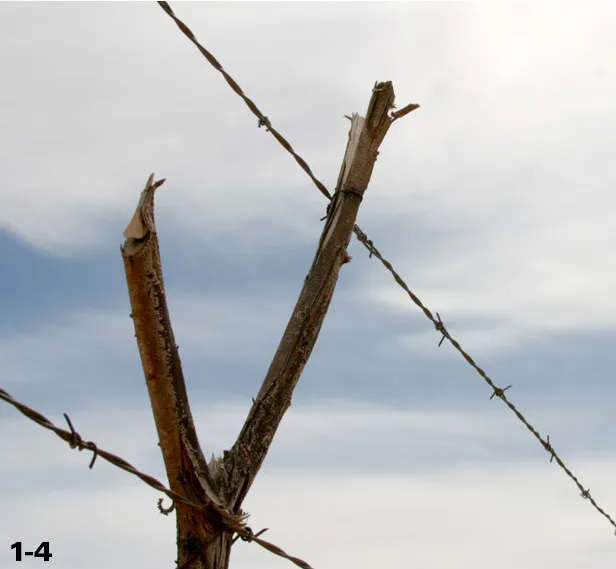

1-4: Figure 1-4 is an example of a landscape in macro form. The connotations of b...
Table of contents
- Cover
- Table of Contents
- Title Page
- Foreword
- Chapter 1: First Steps Into a Macro World
- Chapter 2: Equipment
- Chapter 3: Lighting in Macro Photography
- Chapter 4: The Macro in Everyday Objects
- Chapter 5: Flowers
- Chapter 6: Textures
- Chapter 7: Insects
- Chapter 8: Abstracts
- Chapter 9: People
- Chapter 10: The Digital Darkroom
- Appendix A: Internet Resources
- Appendix B: Contributing Photographers
Frequently asked questions
Yes, you can cancel anytime from the Subscription tab in your account settings on the Perlego website. Your subscription will stay active until the end of your current billing period. Learn how to cancel your subscription
No, books cannot be downloaded as external files, such as PDFs, for use outside of Perlego. However, you can download books within the Perlego app for offline reading on mobile or tablet. Learn how to download books offline
Perlego offers two plans: Essential and Complete
- Essential is ideal for learners and professionals who enjoy exploring a wide range of subjects. Access the Essential Library with 800,000+ trusted titles and best-sellers across business, personal growth, and the humanities. Includes unlimited reading time and Standard Read Aloud voice.
- Complete: Perfect for advanced learners and researchers needing full, unrestricted access. Unlock 1.5M+ books across hundreds of subjects, including academic and specialized titles. The Complete Plan also includes advanced features like Premium Read Aloud and Research Assistant.
We are an online textbook subscription service, where you can get access to an entire online library for less than the price of a single book per month. With over 1.5 million books across 990+ topics, we’ve got you covered! Learn about our mission
Look out for the read-aloud symbol on your next book to see if you can listen to it. The read-aloud tool reads text aloud for you, highlighting the text as it is being read. You can pause it, speed it up and slow it down. Learn more about Read Aloud
Yes! You can use the Perlego app on both iOS and Android devices to read anytime, anywhere — even offline. Perfect for commutes or when you’re on the go.
Please note we cannot support devices running on iOS 13 and Android 7 or earlier. Learn more about using the app
Please note we cannot support devices running on iOS 13 and Android 7 or earlier. Learn more about using the app
Yes, you can access Macro Photography Photo Workshop by Haje Jan Kamps in PDF and/or ePUB format, as well as other popular books in Media & Performing Arts & Digital Media. We have over 1.5 million books available in our catalogue for you to explore.